A Museum for a King 4th Grade Story Spectum Reading Grade 4 Reading
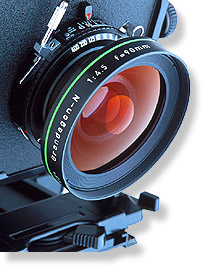 Lens and mounting of a large-format camera | |
| Other names | Science or art of creating durable images |
|---|---|
| Types | Recording light or other electromagnetic radiation |
| Inventor | Louis Daguerre (1839) Henry Fox Talbot (1839) |
| Related | Stereoscopic, Full-spectrum, Light field, Electrophotography, Photograms, Scanner |
Photography is the art, application, and practice of creating durable images by recording calorie-free, either electronically by means of an paradigm sensor, or chemically by means of a light-sensitive material such as photographic film. It is employed in many fields of science, manufacturing (due east.k., photolithography), and business, besides as its more direct uses for art, film and video production, recreational purposes, hobby, and mass communication.[1]
Typically, a lens is used to focus the light reflected or emitted from objects into a real epitome on the light-sensitive surface inside a camera during a timed exposure. With an electronic paradigm sensor, this produces an electrical charge at each pixel, which is electronically processed and stored in a digital epitome file for subsequent display or processing. The issue with photographic emulsion is an invisible latent image, which is later chemically "developed" into a visible image, either negative or positive, depending on the purpose of the photographic material and the method of processing. A negative image on film is traditionally used to photographically create a positive image on a paper base, known every bit a print, either past using an enlarger or by contact printing.
Etymology [edit]
The word "photography" was created from the Greek roots φωτός (phōtós), genitive of φῶς (phōs), "light"[2] and γραφή (graphé) "representation by means of lines" or "drawing",[3] together meaning "cartoon with lite".[iv]
Several people may have coined the same new term from these roots independently. Hercules Florence, a French painter and inventor living in Campinas, Brazil, used the French form of the word, photographie, in individual notes which a Brazilian historian believes were written in 1834.[v] This claim is widely reported just is non yet largely recognized internationally. The beginning use of the discussion by the Franco-Brazilian inventor became widely known later on the research of Boris Kossoy in 1980.[6]
The German newspaper Vossische Zeitung of 25 February 1839 contained an commodity entitled Photographie, discussing several priority claims – especially Henry Play tricks Talbot's – regarding Daguerre's claim of invention.[7] The article is the earliest known occurrence of the word in public print.[8] It was signed "J.Yard.", believed to have been Berlin astronomer Johann von Maedler.[nine] The astronomer Sir John Herschel is likewise credited with coining the word, independent of Talbot, in 1839.[10]
The inventors Nicéphore Niépce, Henry Play a trick on Talbot and Louis Daguerre seem not to accept known or used the give-and-take "photography", but referred to their processes equally "Heliography" (Niépce), "Photogenic Drawing"/"Talbotype"/"Calotype" (Talbot) and "Daguerreotype" (Daguerre).[nine]
History [edit]
Forerunner technologies [edit]
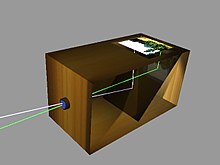
A photographic camera obscura used for drawing
Photography is the outcome of combining several technical discoveries, relating to seeing an image and capturing the epitome. The discovery of the camera obscura ("nighttime chamber" in Latin) that provides an image of a scene dates back to ancient China. Greek mathematicians Aristotle and Euclid independently described a photographic camera obscura in the fifth and 4th centuries BCE.[11] [12] In the 6th century CE, Byzantine mathematician Anthemius of Tralles used a type of camera obscura in his experiments.[13]
The Arab physicist Ibn al-Haytham (Alhazen) (965–1040) too invented a camera obscura equally well as the kickoff true pinhole camera.[12] [fourteen] [15] The invention of the camera has been traced dorsum to the work of Ibn al-Haytham.[sixteen] While the furnishings of a unmarried lite passing through a pinhole had been described earlier,[16] Ibn al-Haytham gave the starting time correct analysis of the photographic camera obscura,[17] including the starting time geometrical and quantitative descriptions of the phenomenon,[18] and was the showtime to use a screen in a night room so that an image from ane side of a hole in the surface could be projected onto a screen on the other side.[19] He also first understood the relationship between the focal point and the pinhole,[xx] and performed early on experiments with afterimages, laying the foundations for the invention of photography in the 19th century.[15]
Leonardo da Vinci mentions natural camerae obscurae that are formed by dark caves on the edge of a sunlit valley. A pigsty in the cave wall will act as a pinhole camera and projection a laterally reversed, upside downward image on a piece of paper. Renaissance painters used the camera obscura which, in fact, gives the optical rendering in color that dominates Western Fine art. It is a box with a small hole in one side, which allows specific light rays to enter, projecting an inverted image onto a viewing screen or paper.
The birth of photography was and then concerned with inventing means to capture and keep the image produced by the photographic camera obscura. Albertus Magnus (1193–1280) discovered silver nitrate,[21] and Georg Fabricius (1516–1571) discovered silvery chloride,[22] and the techniques described in Ibn al-Haytham's Book of Optics are capable of producing primitive photographs using medieval materials.[23] [24]
Daniele Barbaro described a diaphragm in 1566.[25] Wilhelm Homberg described how lite darkened some chemicals (photochemical issue) in 1694.[26] The fiction volume Giphantie, published in 1760, by French writer Tiphaigne de la Roche, described what can be interpreted as photography.[25]
Around the year 1800, British inventor Thomas Wedgwood made the first known attempt to capture the image in a camera obscura by ways of a low-cal-sensitive substance. He used paper or white leather treated with silver nitrate. Although he succeeded in capturing the shadows of objects placed on the surface in direct sunlight, and even made shadow copies of paintings on drinking glass, it was reported in 1802 that "the images formed past means of a photographic camera obscura take been found also faint to produce, in any moderate time, an upshot upon the nitrate of silver." The shadow images eventually darkened all over.[27]
Invention [edit]
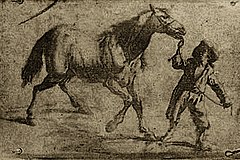
Earliest known surviving heliographic engraving, 1825, printed from a metal plate fabricated past Nicéphore Niépce.[28] The plate was exposed under an ordinary engraving and copied information technology past photographic ways. This was a step towards the first permanent photograph taken with a camera.

View of the Boulevard du Temple, a daguerreotype made past Louis Daguerre in 1838, is generally accepted equally the earliest photograph to include people. It is a view of a decorated street, but because the exposure lasted for several minutes the moving traffic left no trace. But the two men near the bottom left corner, ane of them apparently having his boots polished by the other, remained in one place long enough to exist visible.
The offset permanent photoetching was an image produced in 1822 by the French inventor Nicéphore Niépce, but it was destroyed in a afterward attempt to brand prints from it.[28] Niépce was successful again in 1825. In 1826 or 1827, he made the View from the Window at Le Gras, the earliest surviving photograph from nature (i.e., of the image of a real-earth scene, as formed in a photographic camera obscura by a lens).[29]

Because Niépce'southward camera photographs required an extremely long exposure (at least 8 hours and probably several days), he sought to greatly better his bitumen procedure or replace it with one that was more than applied. In partnership with Louis Daguerre, he worked out mail-exposure processing methods that produced visually superior results and replaced the bitumen with a more than lite-sensitive resin, but hours of exposure in the photographic camera were still required. With an eye to eventual commercial exploitation, the partners opted for total secrecy.
Niépce died in 1833 and Daguerre and so redirected the experiments toward the light-sensitive silverish halides, which Niépce had abandoned many years earlier because of his inability to make the images he captured with them low-cal-fast and permanent. Daguerre's efforts culminated in what would later be named the daguerreotype process. The essential elements—a silver-plated surface sensitized by iodine vapor, adult by mercury vapor, and "fixed" with hot saturated salt water—were in place in 1837. The required exposure fourth dimension was measured in minutes instead of hours. Daguerre took the primeval confirmed photograph of a person in 1838 while capturing a view of a Paris street: different the other pedestrian and horse-drawn traffic on the busy boulevard, which appears deserted, one man having his boots polished stood sufficiently still throughout the several-minutes-long exposure to be visible. The existence of Daguerre's process was publicly announced, without details, on 7 January 1839. The news created an international sensation. France soon agreed to pay Daguerre a alimony in exchange for the correct to nowadays his invention to the world as the gift of France, which occurred when complete working instructions were unveiled on 19 August 1839. In that same year, American lensman Robert Cornelius is credited with taking the earliest surviving photographic self-portrait.
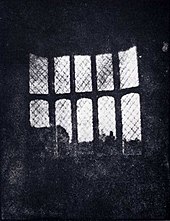
A latticed window in Lacock Abbey, England, photographed by William Fox Talbot in 1835. Shown here in positive course, this may be the oldest extant photographic negative made in a camera.
In Brazil, Hercules Florence had apparently started working out a silver-salt-based newspaper procedure in 1832, later naming it Photographie.
Meanwhile, a British inventor, William Fox Talbot, had succeeded in making crude but reasonably calorie-free-fast silver images on paper every bit early as 1834 but had kept his piece of work secret. After reading about Daguerre's invention in January 1839, Talbot published his hitherto secret method and set about improving on it. At showtime, like other pre-daguerreotype processes, Talbot's paper-based photography typically required hours-long exposures in the photographic camera, but in 1840 he created the calotype procedure, which used the chemic development of a latent epitome to greatly reduce the exposure needed and compete with the daguerreotype. In both its original and calotype forms, Talbot'southward process, different Daguerre's, created a translucent negative which could be used to print multiple positive copies; this is the footing of nearly modernistic chemical photography up to the present day, as daguerreotypes could only exist replicated by rephotographing them with a camera.[30] Talbot's famous tiny newspaper negative of the Oriel window in Lacock Abbey, 1 of a number of camera photographs he made in the summer of 1835, may be the oldest camera negative in existence.[31] [32]
In France, Hippolyte Bayard invented his own process for producing direct positive newspaper prints and claimed to have invented photography earlier than Daguerre or Talbot.[33]
British chemist John Herschel fabricated many contributions to the new field. He invented the cyanotype procedure, subsequently familiar as the "design". He was the first to employ the terms "photography", "negative" and "positive". He had discovered in 1819 that sodium thiosulphate was a solvent of silver halides, and in 1839 he informed Talbot (and, indirectly, Daguerre) that it could exist used to "set" silver-halide-based photographs and make them completely light-fast. He made the starting time glass negative in late 1839.
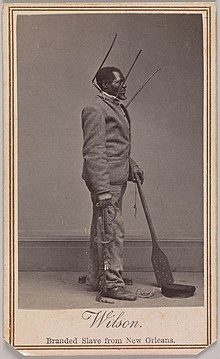
Wilson Chinn, a branded slave from Louisiana--per The New York Times, "one of the primeval and almost dramatic examples of how the newborn medium of photography could change the course of history."[34]
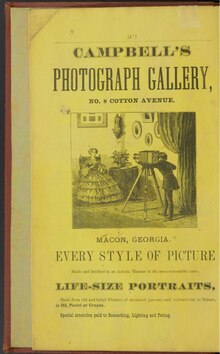
Advertizing for Campbell's Photograph Gallery from The Macon Urban center Directory, circa 1877.
In the March 1851 issue of The Chemist, Frederick Scott Archer published his wet plate collodion process. It became the most widely used photographic medium until the gelatin dry plate, introduced in the 1870s, eventually replaced it. At that place are three subsets to the collodion procedure; the Ambrotype (a positive image on glass), the Ferrotype or Tintype (a positive image on metal) and the drinking glass negative, which was used to make positive prints on albumen or salted paper.
Many advances in photographic glass plates and printing were fabricated during the rest of the 19th century. In 1891, Gabriel Lippmann introduced a procedure for making natural-color photographs based on the optical miracle of the interference of light waves. His scientifically elegant and of import but ultimately impractical invention earned him the Nobel Prize in Physics in 1908.
Drinking glass plates were the medium for most original photographic camera photography from the belatedly 1850s until the general introduction of flexible plastic films during the 1890s. Although the convenience of the film greatly popularized amateur photography, early films were somewhat more expensive and of markedly lower optical quality than their glass plate equivalents, and until the tardily 1910s they were not bachelor in the large formats preferred by near professional photographers, so the new medium did not immediately or completely supercede the old. Because of the superior dimensional stability of glass, the utilize of plates for some scientific applications, such as astrophotography, continued into the 1990s, and in the niche field of laser holography, it has persisted into the 21st century.
Motion-picture show [edit]
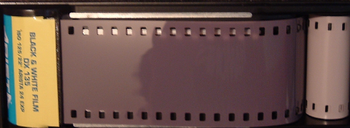
Undeveloped Arista black-and-white picture show, ISO 125/22°
Hurter and Driffield began pioneering work on the light sensitivity of photographic emulsions in 1876. Their work enabled the start quantitative measure of moving picture speed to be devised.
The first flexible photographic scroll film was marketed by George Eastman, founder of Kodak in 1885, but this original "flick" was actually a coating on a newspaper base. As function of the processing, the image-begetting layer was stripped from the paper and transferred to a hardened gelatin support. The first transparent plastic curlicue moving-picture show followed in 1889. It was made from highly flammable nitrocellulose known as nitrate film.
Although cellulose acetate or "safety moving-picture show" had been introduced by Kodak in 1908,[35] at first it found only a few special applications as an culling to the hazardous nitrate motion-picture show, which had the advantages of being considerably tougher, slightly more transparent, and cheaper. The changeover was non completed for 10-ray films until 1933, and although safety film was ever used for 16 mm and 8 mm home movies, nitrate picture show remained standard for theatrical 35 mm motility pictures until information technology was finally discontinued in 1951.
Films remained the dominant form of photography until the early 21st century when advances in digital photography drew consumers to digital formats.[36] Although mod photography is dominated past digital users, motion picture continues to exist used by enthusiasts and professional photographers. The distinctive "expect" of motion-picture show based photographs compared to digital images is probable due to a combination of factors, including: (1) differences in spectral and tonal sensitivity (Southward-shaped density-to-exposure (H&D curve) with film vs. linear response curve for digital CCD sensors)[37] (2) resolution and (three) continuity of tone.[38]
Black-and-white [edit]

Originally, all photography was monochrome, or black-and-white. Fifty-fifty subsequently color flick was readily available, blackness-and-white photography continued to dominate for decades, due to its lower cost, chemic stability, and its "archetype" photographic await. The tones and contrast between light and dark areas define black-and-white photography.[39] Monochromatic pictures are not necessarily composed of pure blacks, whites, and intermediate shades of greyness but can involve shades of i particular hue depending on the process. The cyanotype process, for instance, produces an image equanimous of blue tones. The albumen print process, publicly revealed in 1847, produces brownish tones.
Many photographers go on to produce some monochrome images, sometimes because of the established archival permanence of well-processed silver-halide-based materials. Some total-color digital images are processed using a variety of techniques to create black-and-white results, and some manufacturers produce digital cameras that exclusively shoot monochrome. Monochrome printing or electronic display can be used to salvage certain photographs taken in colour which are unsatisfactory in their original form; sometimes when presented as black-and-white or unmarried-color-toned images they are plant to be more effective. Although color photography has long predominated, monochrome images are notwithstanding produced, by and large for artistic reasons. Almost all digital cameras have an option to shoot in monochrome, and almost all paradigm editing software tin combine or selectively discard RGB color channels to produce a monochrome image from one shot in color.
Color [edit]
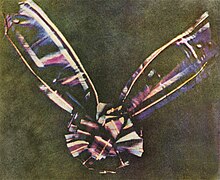
Color photography was explored offset in the 1840s. Early experiments in color required extremely long exposures (hours or days for camera images) and could non "fix" the photograph to foreclose the color from chop-chop fading when exposed to white lite.
The first permanent color photograph was taken in 1861 using the three-colour-separation principle first published by Scottish physicist James Clerk Maxwell in 1855.[40] [41] The foundation of virtually all practical color processes, Maxwell'due south idea was to take three divide black-and-white photographs through ruby, green and blue filters.[40] [41] This provides the lensman with the three basic channels required to recreate a color prototype. Transparent prints of the images could be projected through similar color filters and superimposed on the project screen, an additive method of color reproduction. A color impress on paper could be produced by superimposing carbon prints of the three images made in their complementary colors, a subtractive method of colour reproduction pioneered by Louis Ducos du Hauron in the tardily 1860s.
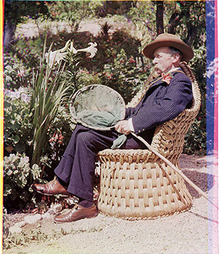
Color photography was possible long before Kodachrome, as this 1903 portrait past Sarah Angelina Acland demonstrates, but in its earliest years, the need for special equipment, long exposures, and complicated press processes fabricated it extremely rare.
Russian photographer Sergei Mikhailovich Prokudin-Gorskii fabricated extensive use of this color separation technique, employing a special camera which successively exposed the three color-filtered images on dissimilar parts of an oblong plate. Because his exposures were not simultaneous, unsteady subjects exhibited color "fringes" or, if rapidly moving through the scene, appeared as brightly colored ghosts in the resulting projected or printed images.
Implementation of color photography was hindered by the limited sensitivity of early photographic materials, which were mostly sensitive to blue, only slightly sensitive to dark-green, and almost insensitive to red. The discovery of dye sensitization by photochemist Hermann Vogel in 1873 suddenly made it possible to add together sensitivity to green, yellow and fifty-fifty red. Improved colour sensitizers and ongoing improvements in the overall sensitivity of emulsions steadily reduced the once-prohibitive long exposure times required for colour, bringing it ever closer to commercial viability.
Autochrome, the first commercially successful color procedure, was introduced by the Lumière brothers in 1907. Autochrome plates incorporated a mosaic color filter layer made of dyed grains of spud starch, which immune the three color components to be recorded as adjacent microscopic epitome fragments. After an Autochrome plate was reversal candy to produce a positive transparency, the starch grains served to illuminate each fragment with the correct colour and the tiny colored points blended together in the eye, synthesizing the colour of the discipline by the additive method. Autochrome plates were one of several varieties of additive color screen plates and films marketed betwixt the 1890s and the 1950s.
Kodachrome, the first modern "integral tripack" (or "monopack") colour pic, was introduced past Kodak in 1935. Information technology captured the 3 colour components in a multi-layer emulsion. 1 layer was sensitized to tape the red-dominated part of the spectrum, some other layer recorded merely the green office and a third recorded but the blue. Without special picture processing, the result would merely be three superimposed blackness-and-white images, but complementary cyan, magenta, and xanthous dye images were created in those layers by adding color couplers during a complex processing procedure.
Agfa's similarly structured Agfacolor Neu was introduced in 1936. Unlike Kodachrome, the colour couplers in Agfacolor Neu were incorporated into the emulsion layers during manufacture, which greatly simplified the processing. Currently, available color films yet employ a multi-layer emulsion and the same principles, nearly closely resembling Agfa's product.
Instant colour moving picture, used in a special camera which yielded a unique finished colour print only a minute or 2 after the exposure, was introduced by Polaroid in 1963.
Colour photography may form images every bit positive transparencies, which can be used in a slide projector, or equally color negatives intended for employ in creating positive color enlargements on specially coated paper. The latter is at present the nigh common form of motion picture (non-digital) color photography attributable to the introduction of automated photograph printing equipment. Afterward a transition period centered around 1995–2005, color picture show was relegated to a niche market place by inexpensive multi-megapixel digital cameras. Film continues to be the preference of some photographers because of its distinctive "expect".
Digital [edit]
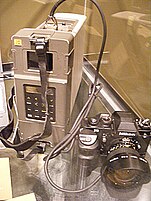
Kodak DCS 100, based on a Nikon F3 body with Digital Storage Unit
In 1981, Sony unveiled the first consumer camera to use a charge-coupled device for imaging, eliminating the need for film: the Sony Mavica. While the Mavica saved images to disk, the images were displayed on television set, and the photographic camera was not fully digital.
The first digital camera to both record and save images in a digital format was the Fujix DS-1P created by Fujfilm in 1988.[42]
In 1991, Kodak unveiled the DCS 100, the first commercially available digital single lens reflex camera. Although its high price precluded uses other than photojournalism and professional photography, commercial digital photography was born.
Digital imaging uses an electronic image sensor to tape the image every bit a set of electronic information rather than equally chemical changes on picture.[43] An of import difference between digital and chemical photography is that chemic photography resists photo manipulation because information technology involves film and photographic paper, while digital imaging is a highly manipulative medium. This divergence allows for a caste of image mail-processing that is insufficiently difficult in film-based photography and permits dissimilar communicative potentials and applications.

Photography on a smartphone
Digital photography dominates the 21st century. More than 99% of photographs taken around the earth are through digital cameras, increasingly through smartphones.
Techniques [edit]

Angles such as vertical, horizontal, or equally pictured hither diagonal are considered important photographic techniques
A big variety of photographic techniques and media are used in the process of capturing images for photography. These include the photographic camera; dualphotography; full-spectrum, ultraviolet and infrared media; lite field photography; and other imaging techniques.
Cameras [edit]
The camera is the image-forming device, and a photographic plate, photographic pic or a silicon electronic image sensor is the capture medium. The corresponding recording medium can be the plate or film itself, or a digital magnetic or electronic retention.[44]
Photographers command the camera and lens to "expose" the lite recording material to the required corporeality of light to form a "latent epitome" (on plate or film) or RAW file (in digital cameras) which, after appropriate processing, is converted to a usable image. Digital cameras use an electronic image sensor based on light-sensitive electronics such as accuse-coupled device (CCD) or complementary metal-oxide-semiconductor (CMOS) technology. The resulting digital image is stored electronically, but can be reproduced on a paper.
The camera (or 'camera obscura') is a night room or chamber from which, as far every bit possible, all lite is excluded except the light that forms the epitome. It was discovered and used in the 16th century by painters. The subject existence photographed, nonetheless, must exist illuminated. Cameras can range from small-scale to very large, a whole room that is kept dark while the object to exist photographed is in another room where it is properly illuminated. This was common for reproduction photography of flat copy when large motion-picture show negatives were used (see Process camera).
As soon equally photographic materials became "fast" (sensitive) plenty for taking aboveboard or surreptitious pictures, small "detective" cameras were fabricated, some actually bearded as a volume or handbag or pocket picket (the Ticka camera) or even worn hidden behind an Ascot tie with a necktie pin that was really the lens.
The motion picture camera is a type of photographic camera which takes a rapid sequence of photographs on recording medium. In contrast to a still camera, which captures a single snapshot at a time, the flick camera takes a series of images, each called a "frame". This is accomplished through an intermittent mechanism. The frames are later played back in a movie projector at a specific speed, called the "frame rate" (number of frames per second). While viewing, a person's optics and encephalon merge the separate pictures to create the illusion of move.[45]
Stereoscopic [edit]
Photographs, both monochrome and color, tin be captured and displayed through two side-past-side images that emulate human stereoscopic vision. Stereoscopic photography was the kickoff that captured figures in movement.[46] While known colloquially as "3-D" photography, the more than authentic term is stereoscopy. Such cameras accept long been realized past using film and more than recently in digital electronic methods (including cell phone cameras).
Dualphotography [edit]

An example of a dualphoto using a smartphone based app
Dualphotography consists of photographing a scene from both sides of a photographic device at one time (due east.grand. photographic camera for back-to-back dualphotography, or two networked cameras for portal-airplane dualphotography). The dualphoto apparatus tin can be used to simultaneously capture both the subject field and the photographer, or both sides of a geographical identify at once, thus adding a supplementary narrative layer to that of a unmarried image.[47]
Full-spectrum, ultraviolet and infrared [edit]
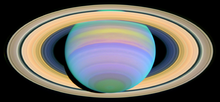
Ultraviolet and infrared films take been bachelor for many decades and employed in a variety of photographic avenues since the 1960s. New technological trends in digital photography have opened a new direction in full spectrum photography, where conscientious filtering choices across the ultraviolet, visible and infrared pb to new artistic visions.
Modified digital cameras can detect some ultraviolet, all of the visible and much of the near infrared spectrum, every bit most digital imaging sensors are sensitive from most 350 nm to 1000 nm. An off-the-shelf digital camera contains an infrared hot mirror filter that blocks near of the infrared and a bit of the ultraviolet that would otherwise be detected by the sensor, narrowing the accepted range from about 400 nm to 700 nm.[48]
Replacing a hot mirror or infrared blocking filter with an infrared pass or a wide spectrally transmitting filter allows the camera to observe the wider spectrum calorie-free at greater sensitivity. Without the hot-mirror, the scarlet, green and blue (or cyan, yellowish and magenta) colored micro-filters placed over the sensor elements pass varying amounts of ultraviolet (blueish window) and infrared (primarily ruby and somewhat bottom the light-green and blueish micro-filters).
Uses of full spectrum photography are for fine fine art photography, geology, forensics and police enforcement.
Layering [edit]
Layering is a photographic composition technique that manipulates the foreground, subject or middle-ground, and background layers in a style that they all work together to tell a story through the image.[49] Layers may be incorporated by altering the focal length, distorting the perspective by positioning the camera in a certain spot.[l] People, movement, light and a diverseness of objects can be used in layering.[51]
Low-cal field [edit]
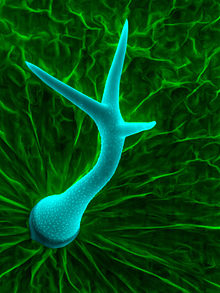
Digital methods of image capture and display processing take enabled the new technology of "low-cal field photography" (as well known as constructed aperture photography). This process allows focusing at various depths of field to exist selected afterwards the photograph has been captured.[52] Equally explained past Michael Faraday in 1846, the "light field" is understood every bit 5-dimensional, with each bespeak in three-D infinite having attributes of 2 more than angles that define the direction of each ray passing through that point.
These additional vector attributes can be captured optically through the use of microlenses at each pixel point within the 2-dimensional image sensor. Every pixel of the final image is actually a selection from each sub-assortment located nether each microlens, as identified by a post-image capture focus algorithm.
Other [edit]
Too the camera, other methods of forming images with light are available. For example, a photocopy or xerography machine forms permanent images merely uses the transfer of static electric charges rather than photographic medium, hence the term electrophotography. Photograms are images produced by the shadows of objects cast on the photographic newspaper, without the use of a camera. Objects can also be placed directly on the drinking glass of an prototype scanner to produce digital pictures.
Types [edit]
Amateur [edit]
Amateur photographers take photos for personal utilize, every bit a hobby or out of casual interest, rather than equally a business concern or task. The quality amateur work can be comparable to that of many professionals. Amateurs can fill up a gap in subjects or topics that might not otherwise be photographed if they are non commercially useful or salable. Amateur photography grew during the late 19th century due to the popularization of the mitt-held camera.[53] 20-first century social media and about-ubiquitous photographic camera phones have made photographic and video recording pervasive in everyday life. In the mid-2010s smartphone cameras added numerous automated assistance features like color direction, autofocus face detection and image stabilization that significantly decreased skill and effort needed to accept high quality images.[54]
Commercial [edit]
Commercial photography is probably best defined equally whatsoever photography for which the photographer is paid for images rather than works of art. In this light, coin could be paid for the subject of the photo or the photograph itself. Wholesale, retail, and professional uses of photography would fall nether this definition. The commercial photographic world could include:
- Ad photography: photographs made to illustrate and usually sell a service or production. These images, such as packshots, are generally done with an ad agency, design firm or with an in-house corporate design team.
- Architectural photography focuses on capturing photographs of buildings and architectural structures that are aesthetically pleasing and accurate in terms of representations of their subjects.
- Result photography focuses on photographing guests and occurrences at by and large social events.
- Manner and glamour photography usually incorporates models and is a form of advertising photography. Fashion photography, like the work featured in Harper's Bazaar, emphasizes clothes and other products; glamour emphasizes the model and body form. Glamour photography is popular in advertizement and men'southward magazines. Models in glamour photography sometimes work nude.
- 360 production photography displays a series of photos to give the impression of a rotating object. This technique is commonly used by ecommerce websites to help shoppers visualise products.
- Concert photography focuses on capturing candid images of both the creative person or band likewise as the temper (including the oversupply). Many of these photographers work freelance and are contracted through an artist or their management to comprehend a specific show. Concert photographs are ofttimes used to promote the creative person or ring in addition to the venue.
- Crime scene photography consists of photographing scenes of crime such as robberies and murders. A black and white camera or an infrared camera may exist used to capture specific details.
- Still life photography usually depicts inanimate subject matter, typically commonplace objects which may exist either natural or human-made. All the same life is a broader category for food and some natural photography and can be used for advertising purposes.
- Real Estate photography focuses on the production of photographs showcasing a holding that is for sale, such photographs requires the use of wide-lens and extensive knowledge in High-dynamic-range imaging photography.

Example of a studio-made food photograph.
- Nutrient photography can be used for editorial, packaging or advertising utilise. Food photography is similar to all the same life photography but requires some special skills.
- Photojournalism can be considered a subset of editorial photography. Photographs fabricated in this context are accepted as a documentation of a news story.
- Paparazzi is a class of photojournalism in which the lensman captures candid images of athletes, celebrities, politicians, and other prominent people.
- Portrait and wedding photography: photographs fabricated and sold straight to the terminate user of the images.
- Landscape photography depicts locations.
- Wildlife photography demonstrates the life of wild animals.
Art [edit]
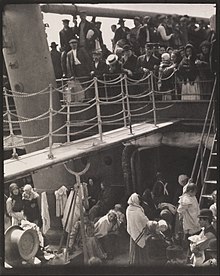
During the 20th century, both fine art photography and documentary photography became accepted by the English-speaking fine art world and the gallery system. In the United States, a handful of photographers, including Alfred Stieglitz, Edward Steichen, John Szarkowski, F. Holland Solar day, and Edward Weston, spent their lives advocating for photography every bit a fine art. At first, fine art photographers tried to imitate painting styles. This movement is called Pictorialism, oft using soft focus for a dreamy, 'romantic' look. In reaction to that, Weston, Ansel Adams, and others formed the Grouping f/64 to advocate 'straight photography', the photograph as a (sharply focused) thing in itself and non an imitation of something else.
The aesthetics of photography is a thing that continues to be discussed regularly, especially in artistic circles. Many artists argued that photography was the mechanical reproduction of an paradigm. If photography is authentically art, and so photography in the context of fine art would demand redefinition, such as determining what component of a photograph makes information technology cute to the viewer. The controversy began with the primeval images "written with light"; Nicéphore Niépce, Louis Daguerre, and others among the very earliest photographers were met with acclaim, merely some questioned if their work met the definitions and purposes of fine art.
Clive Bell in his classic essay Art states that only "meaning form" can distinguish art from what is not fine art.
There must be some one quality without which a work of art cannot exist; possessing which, in the to the lowest degree degree, no work is altogether worthless. What is this quality? What quality is shared past all objects that provoke our aesthetic emotions? What quality is common to Sta. Sophia and the windows at Chartres, Mexican sculpture, a Persian bowl, Chinese carpets, Giotto's frescoes at Padua, and the masterpieces of Poussin, Piero della Francesca, and Cezanne? Merely 1 answer seems possible – significant form. In each, lines and colors combined in a particular style, certain forms and relations of forms, stir our aesthetic emotions.[55]
On 7 February 2007, Sotheby'southward London sold the 2001 photograph 99 Cent Two Diptychon for an unprecedented $iii,346,456 to an anonymous bidder, making information technology the about expensive at the time.[56]
Conceptual photography turns a concept or idea into a photograph. Even though what is depicted in the photographs are existent objects, the subject is strictly abstract.
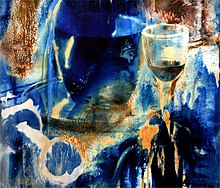
In parallel to this development, the then largely separate interface between painting and photography was closed in the early on 1970s with the work of the photo artists Pierre Cordier (Chimigramm), Chemigram and Josef H. Neumann, Chemogram. In 1974 the chemograms by Josef H. Neumann concluded the separation of the painterly background and the photographic layer by showing the flick elements in a symbiosis that had never existed earlier, as an unmistakable unique specimen, in a simultaneous painterly and at the same fourth dimension real photographic perspective, using lenses, inside a photographic layer, united in colors and shapes. This Neumann chemogram from the seventies of the 20th century thus differs from the beginning of the previously created cameraless chemigrams of a Pierre Cordier and the photogram Homo Ray or László Moholy-Nagy of the previous decades. These works of art were almost simultaneous with the invention of photography by various important artists who characterized Hippolyte Bayard, Thomas Wedgwood, William Henry Play a trick on Talbot in their early stages, and later Man Ray and László Moholy-Nagy in the twenties and by the painter in the thirties Edmund Kesting and Christian Schad by draping objects directly onto appropriately sensitized photo paper and using a light source without a camera. [57]
Photojournalism [edit]

National Guardsman in Washington D.C. (2021)
Photojournalism is a particular course of photography (the collecting, editing, and presenting of news textile for publication or broadcast) that employs images in order to tell a news story. It is at present usually understood to refer but to still images, but in some cases the term besides refers to video used in broadcast journalism. Photojournalism is distinguished from other close branches of photography (e.thou., documentary photography, social documentary photography, street photography or celebrity photography) past complying with a rigid ethical framework which demands that the piece of work exist both honest and impartial whilst telling the story in strictly journalistic terms. Photojournalists create pictures that contribute to the news media, and help communities connect with one other. Photojournalists must be well informed and knowledgeable about events happening correct outside their door. They evangelize news in a artistic format that is non only informative, simply also entertaining, including sports photography.
Scientific discipline and forensics [edit]

The camera has a long and distinguished history as a means of recording scientific phenomena from the outset apply past Daguerre and Fob-Talbot, such every bit astronomical events (eclipses for case), small creatures and plants when the photographic camera was attached to the eyepiece of microscopes (in photomicroscopy) and for macro photography of larger specimens. The camera also proved useful in recording crime scenes and the scenes of accidents, such every bit the Wootton bridge collapse in 1861. The methods used in analysing photographs for use in legal cases are collectively known as forensic photography. Crime scene photos are taken from three vantage indicate. The vantage points are overview, mid-range, and close-upward.[58]
In 1845 Francis Ronalds, the Honorary Director of the Kew Observatory, invented the first successful photographic camera to make continuous recordings of meteorological and geomagnetic parameters. Different machines produced 12- or 24- 60 minutes photographic traces of the infinitesimal-by-minute variations of atmospheric pressure, temperature, humidity, atmospheric electricity, and the three components of geomagnetic forces. The cameras were supplied to numerous observatories around the world and some remained in apply until well into the 20th century.[59] [60] Charles Brooke a trivial subsequently adult similar instruments for the Greenwich Observatory.[61]
Science uses image technology that has derived from the design of the Pivot Hole camera. X-Ray machines are similar in blueprint to Pivot Hole cameras with high-grade filters and laser radiation.[62] Photography has become universal in recording events and information in science and engineering science, and at crime scenes or accident scenes. The method has been much extended by using other wavelengths, such equally infrared photography and ultraviolet photography, equally well every bit spectroscopy. Those methods were first used in the Victorian era and improved much further since that time.[63]
The first photographed cantlet was discovered in 2012 by physicists at Griffith University, Australia. They used an electrical field to trap an "Ion" of the element, Ytterbium. The image was recorded on a CCD, an electronic photographic motion-picture show.[64]
Wildlife Photography [edit]
Wild animals photography involves capturing images of various forms of wildlife. Unlike other forms of photography such equally product or food photography, successful wildlife photography requires a photographer to cull the correct identify and correct time when specific wildlife are present and active. It oftentimes requires great patience and considerable skill and control of the right photographic equipment.[65]
Social and cultural implications [edit]
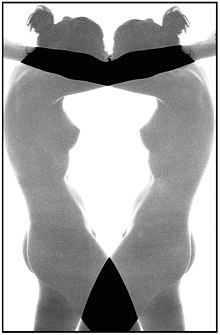
There are many ongoing questions about different aspects of photography. In her On Photography (1977), Susan Sontag dismisses the objectivity of photography. This is a highly debated subject field within the photographic community.[66] Sontag argues, "To photograph is to appropriate the thing photographed. Information technology means putting one's self into a certain relation to the world that feels like knowledge, and therefore similar power."[67] Photographers determine what to take a photo of, what elements to exclude and what angle to frame the photo, and these factors may reverberate a particular socio-historical context. Forth these lines, information technology can exist argued that photography is a subjective grade of representation.
Modern photography has raised a number of concerns on its event on society. In Alfred Hitchcock'south Rear Window (1954), the camera is presented every bit promoting voyeurism. 'Although the camera is an observation station, the act of photographing is more than than passive observing'.[67]
The photographic camera doesn't rape or even possess, though it may presume, intrude, trespass, distort, exploit, and, at the farthest achieve of metaphor, assassinate – all activities that, unlike the sexual push and shove, tin be conducted from a distance, and with some disengagement.[67]
Digital imaging has raised ethical concerns considering of the ease of manipulating digital photographs in post-processing. Many photojournalists accept alleged they will not crop their pictures or are forbidden from combining elements of multiple photos to make "photomontages", passing them equally "real" photographs. Today's technology has made image editing relatively simple for even the novice lensman. Notwithstanding, recent changes of in-camera processing permit digital fingerprinting of photos to find tampering for purposes of forensic photography.
Photography is one of the new media forms that changes perception and changes the construction of gild.[68] Further unease has been caused effectually cameras in regards to desensitization. Fears that disturbing or explicit images are widely accessible to children and society at large have been raised. Particularly, photos of war and pornography are causing a stir. Sontag is concerned that "to photograph is to turn people into objects that tin be symbolically possessed." Desensitization discussion goes hand in mitt with debates about censored images. Sontag writes of her business concern that the ability to censor pictures means the photographer has the power to construct reality.[67]
Ane of the practices through which photography constitutes lodge is tourism. Tourism and photography combine to create a "tourist gaze"[69] in which local inhabitants are positioned and defined by the camera lens. Nonetheless, it has also been argued that at that place exists a "reverse gaze"[70] through which ethnic photographees tin can position the tourist photographer equally a shallow consumer of images.
Constabulary [edit]
Photography is both restricted and protected by the police in many jurisdictions. Protection of photographs is typically accomplished through the granting of copyright or moral rights to the photographer. In the United States, photography is protected equally a First Amendment right and anyone is free to photograph anything seen in public spaces as long as it is in plainly view.[71] In the UK a recent law (Counter-Terrorism Human activity 2008) increases the ability of the police to prevent people, even press photographers, from taking pictures in public places.[72] In S Africa, whatever person may photo whatsoever other person, without their permission, in public spaces and the only specific restriction placed on what may not be photographed by government is related to anything classed as national security. Each country has dissimilar laws.
See as well [edit]
- Outline of photography
- Science of photography
- Listing of photographers
- List of photography awards
- Astrophotography
- Prototype editing
- Imaging
- Photolab and minilab
- Visual arts
References [edit]
- ^ Spencer, D A (1973). The Focal Lexicon of Photographic Technologies. Focal Press. p. 454. ISBN978-0-13-322719-two.
- ^ φάος Archived 25 May 2013 at the Wayback Car, Henry George Liddell, Robert Scott, A Greek-English Lexicon, on Perseus
- ^ γραφή Archived 25 May 2013 at the Wayback Machine, Henry George Liddell, Robert Scott, A Greek-English language Lexicon, on Perseus
- ^ Harper, Douglas. "photograph". Online Etymology Lexicon.
- ^ Boris Kossoy (2004). Hercule Florence: El descubrimiento de la fotografía en Brasil. Instituto Nacional de Antropología e Historia. ISBN978-968-03-0020-4. Archived from the original on 28 April 2016. Retrieved xiii Dec 2015.
- ^ Boris Kossoy (1980). Hercule Florence: a descoberta isolada da fotografia no Brasil. São Paulo: Duas Cidades. ISBN9788531409448.
- ^ "Photophys.com: The Science of Photography: Appreciation through Understanding". photophys.com. Archived from the original on xviii January 2017. Retrieved 25 June 2019.
- ^ Mathur, P, K & S (6 March 2014). Developments and Changes in Scientific discipline Based Technologies. Partridge Publishing. p. fifty. ISBN9781482813982 . Retrieved 25 June 2019.
- ^ a b Eder, J.Grand. (1945) [1932]. History of Photography, quaternary. edition [Geschichte der Photographie]. New York: Dover Publications, Inc. pp. 258–59. ISBN978-0-486-23586-8.
- ^ "Sir John Frederick William Herschel (British, 1792–1871) (Getty Museum)". The J. Paul Getty in Los Angeles. Archived from the original on i Oct 2018. Retrieved 20 June 2019.
- ^ Campbell, Jan (2005) Film and cinema spectatorship: melodrama and mimesis Archived 29 April 2016 at the Wayback Machine. Polity. p. 114. ISBN 0-7456-2930-X
- ^ a b Krebs, Robert E. (2004). Groundbreaking Scientific Experiments, Inventions, and Discoveries of the Middle Ages and the Renaissance. Greenwood Publishing Group. p. 20. ISBN978-0-313-32433-8.
- ^ Crombie, Alistair Cameron (1990) Science, optics, and music in medieval and early on modern thought. A&C Black. p. 205. ISBN 978-0-907628-79-8
- ^ Wade, Nicholas J.; Finger, Stanley (2001). "The eye as an optical instrument: from camera obscura to Helmholtz's perspective". Perception. 30 (x): 1157–77. doi:10.1068/p3210. PMID 11721819. S2CID 8185797.
- ^ a b Plott, John C. (1984). Global History of Philosophy: The Period of scholasticism (part one). p. 460. ISBN978-0-89581-678-8.
According to Nazir Ahmed if only Ibn-Haitham'south swain-workers and students had been as warning as he, they might even have invented the fine art of photography since al-Haitham's experiments with convex and concave mirrors and his invention of the "pinhole photographic camera" whereby the inverted image of a candle-flame is projected were among his many successes in experimentation. One might likewise almost claim that he had anticipated much that the nineteenth century Fechner did in experimentation with after-images.
- ^ a b Belbachir, Ahmed Nabil (2009). Smart Cameras. Springer Science & Business Media. ISBN978-i-4419-0953-4.
The invention of the camera can be traced dorsum to the 10th century when the Arab scientist Al-Hasan Ibn al-Haytham allonym Alhacen provided the first articulate description and correct analysis of the (human) vision process. Although the effects of unmarried low-cal passing through the pinhole have already been described past the Chinese Mozi (Lat. Micius) (fifth century B), the Greek Aristotle (quaternary century BC), and the Arab
- ^ Wade, Nicholas J.; Finger, Stanley (2001), "The center as an optical instrument: from camera obscura to Helmholtz's perspective", Perception, 30 (10): 1157–1177, doi:10.1068/p3210, PMID 11721819, S2CID 8185797,
The principles of the camera obscura start began to be correctly analysed in the eleventh century, when they were outlined past Ibn al-Haytham.
- ^ Needham, Joseph. Science and Civilization in Cathay, vol. Four, role 1: Physics and Physical Technology (PDF). p. 98. Archived from the original (PDF) on three July 2017. Retrieved 5 September 2016.
Alhazen used the photographic camera obscura peculiarly for observing solar eclipses, as indeed Aristotle is said to have done, and information technology seems that, like Shen Kua, he had predecessors in its report, since he did not merits it every bit whatsoever new finding of his own. But his treatment of it was competently geometrical and quantitative for the first time.
- ^ "Who Invented Photographic camera Obscura?". Photography History Facts.
All these scientists experimented with a small hole and light merely none of them suggested that a screen is used so an prototype from ane side of a hole in surface could be projected at the screen on the other. Starting time ane to do so was Alhazen (also known as Ibn al-Haytham) in 11th century.
- ^ Needham, Joseph. Science and Culture in People's republic of china, vol. IV, part 1: Physics and Physical Engineering (PDF). p. 99. Archived from the original (PDF) on three July 2017. Retrieved 5 September 2016.
The genius of Shen Kua's insight into the relation of focal indicate and pinhole tin better be appreciated when we read in Vocalist that this was first understood in Europe by Leonardo da Vinci (+ 1452 to + 1519), almost v hundred years later. A diagram showing the relation occurs in the Codice Atlantico, Leonardo thought that the lens of the eye reversed the pinhole effect, and then that the image did non appear inverted on the retina; though in fact it does. Actually, the analogy of focal-betoken and pivot-point must have been understood by Ibn al-Haitham, who died just nigh the time when Shen Kua was born.
- ^ Davidson, Michael W (13 November 2015). "Albertus Magnus". Molecular Expressions: Science, Optics and You lot. National High Magnetic Field Laboratory at The Florida State University. Archived from the original on 22 December 2015.
- ^ Potonniée, Georges (1973). The history of the discovery of photography. Arno Printing. p. 50. ISBN 0-405-04929-iii
- ^ Allen, Nicholas P.Fifty. (1994). "A reappraisal of late thirteenth-century responses to the Shroud of Lirey-Chambéry-Turin: encolpia of the Eucharist, vera eikon or supreme relic?". The Southern African Journal of Medieval and Renaissance Studies. 4 (1): 62–94.
- ^ Allen, Nicholas P.Fifty. "Verification of the Nature and Causes of the Photo-negative Images on the Shroud of Lirey-Chambéry-Turin". unisa.air conditioning.za
- ^ a b Gernsheim, Helmut (1986). A curtailed history of photography Archived 29 April 2016 at the Wayback Machine. Courier Dover Publications. pp. iii–4. ISBN 0-486-25128-iv
- ^ Gernsheim, Helmut and Gernsheim, Alison (1955) The history of photography from the primeval use of the camera obscura in the eleventh century up to 1914. Oxford University Press. p. xx.
- ^ Litchfield, R. 1903. "Tom Wedgwood, the First Photographer: An Account of His Life." London, Duckworth and Co. Encounter Chapter XIII. Includes the complete text of Humphry Davy's 1802 paper, which is the but known contemporary record of Wedgwood'due south experiments. (Retrieved 7 May 2013 via annal.org Archived seven October 2015 at the Wayback Auto).
- ^ a b "The Outset Photograph – Heliography". Archived from the original on 6 Oct 2009. Retrieved 29 September 2009.
from Helmut Gernsheim's commodity, "The 150th Ceremony of Photography," in History of Photography, Vol. I, No. i, January 1977: ...In 1822, Niépce coated a glass plate... The sunlight passing through... This first permanent example... was destroyed... some years later.
- ^ Hirsch, Robert (1999). Seizing the light: a history of photography. McGraw-Hill. ISBN978-0-697-14361-seven. Archived from the original on 29 April 2016. Retrieved 13 December 2015.
- ^ William Henry Flim-flam Talbot (1800–1877) Archived 3 October 2010 at the Wayback Car. BBC
- ^ Feldman, Anthony and Ford, Peter (1989) Scientists & inventors. Bloomsbury Books, p. 128, ISBN 1-870630-23-8.
- ^ Fox Talbot, William Henry and Jammes, André (1973) William H. Fox Talbot, inventor of the negative-positive process, Macmillan, p. 95.
- ^ "Hippolyte Bayard (French, 1801–1887) (Getty Museum)". Archived from the original on 24 October 2013. Retrieved 21 April 2019.
- ^ Paulson Gage, Joan (5 August 2013). "Icons of Cruelty". The New York Times.
- ^ History of Kodak, Milestones-chronology: 1878–1929 Archived 10 February 2012 at the Wayback Machine. kodak.com
- ^ Peres, Michael R. (2008). The Concise Focal Encyclopedia of Photography: from the first photograph on newspaper to the digital revolution. Burlington, MA: Focal Press/Elsevier. p. 75. ISBN978-0-240-80998-four.
- ^ "H&D curve of moving-picture show vs digital" (Forum Give-and-take). Digital Photography Review. 19 April 2004. Archived from the original on 23 September 2015.
- ^ Jacobson, Ralph East. (2000). The Focal Manual of Photography: photographic and digital imaging (9th ed.). Boston, MA: Focal Printing. ISBN978-0-240-51574-8.
- ^ "Black & White Photography". PSA Journal. 77 (12): 38–40. 2011.
- ^ a b "1861: James Clerk Maxwell'due south greatest yr". King's Higher London. three January 2017. Archived from the original on 4 January 2017. Retrieved 3 January 2017.
- ^ a b "From Charles Mackintosh'southward waterproof to Dolly the sheep: 43 innovations Scotland has given the world". The independent. 2 January 2016. Archived from the original on 2 October 2017. Retrieved 2 December 2017.
- ^ "Research & Development". fujifilm.com . Retrieved thirteen January 2022.
{{cite spider web}}: CS1 maint: url-status (link) - ^ Schewe, Jeff (2012). The Digital Negative: Raw Image Processing In Lightroom, Camera Raw, and Photoshop. Berkeley, CA: Peachpit Press, ISBN 0-321-83957-nine, p. 72
- ^ "Glossary: Digital Photography Review". Dpreview.com. Archived from the original on eighteen Jan 2013. Retrieved 24 June 2013.
- ^ Anderson, Joseph; Anderson, Barbara (Spring 1993). "The Myth of Persistence of Vision Revisited". Journal of Film and Video. 45 (1): 3–12. Archived from the original on 24 November 2009.
- ^ Belisle, Brooke (2013). "The Dimensional Image: Overlaps In Stereoscopic, Cinematic, And Digital Depth". Film Criticism. 37/38 (three/1): 117–37.
- ^ Zand, Tristan (8 April 2017). "An introduction to Dualphotography". Dual.Photograph. Medium.com. Archived from the original on xvi April 2017. Retrieved 15 April 2017.
- ^ Twede, David. Introduction to Full-Spectrum and Infrared photography. surrealcolor.110mb.com
- ^ Lackey, Tamara (12 May 2016). "Incorporating Layering Composition Into Your Photography". 42 Due west . Retrieved 14 September 2021.
- ^ Goldby, Dylan (20 January 2019). "Using layers to raise your photography". Fujilove Magazine . Retrieved fourteen September 2021.
- ^ "How to use layering in photography for exceptional photos". Parker Photographic. 1 December 2020. Retrieved 14 September 2021.
- ^ Ng, Ren (July 2006) Digital Calorie-free Field Photography. PhD Thesis, Stanford University
- ^ Peterson, C.A. (2011). "Dwelling Portraiture". History of Photography. 35 (4): 374–87. doi:10.1080/03087298.2011.606727. S2CID 216590139.
- ^ Oloruntimilehin, Israel (17 September 2018). "How To Take Good Pictures With Your Phone". List Dorm. Archived from the original on sixteen Oct 2018.
- ^ Clive Bell. "Art Archived 3 August 2004 at the Wayback Machine", 1914. Retrieved 2 September 2006.
- ^ Schonauer, David (7 March 2007). "The outset $3M photo". PopPhoto. Archived from the original on 18 March 2007.
- ^ Hannes Schmidt: Comments on the chemograms by Josef H. Neumann. Exhibition in the "Fotografik Studio Galerie von Prof. Pan Walther". in: Photo-Presse. Heft 22, 1976, S. 6.
- ^ Rohde, R.R. (2000). Criminal offense Photography. PSA Journal, 66(3), xv.
- ^ Ronalds, B.F. (2016). Sir Francis Ronalds: Father of the Electric Telegraph. London: Majestic Higher Press. ISBN978-1-78326-917-4.
- ^ Ronalds, B.F. (2016). "The Ancestry of Continuous Scientific Recording using Photography: Sir Francis Ronalds' Contribution". European Guild for the History of Photography. Archived from the original on 13 June 2016. Retrieved 2 June 2016.
- ^ Brooke (1853). "Photographic cocky-registering magnetic and meteorological apparatus: Invented by Mr. Brooke of Keppel-Street, London". The Illustrated Magazine of Art. ane (5): 308–11. doi:10.2307/20537989. JSTOR 20537989. Archived from the original on 29 April 2016. Retrieved 13 December 2015.
- ^ Upadhyay, J.; Chakera, J.A.; Navathe, C.P.; Naik, P.A.; Joshi, A.S.; Gupta, P.D. (2006). "Evolution of single frame Ten-ray framing camera for pulsed plasma experiments". Sādhanā. 31 (five): 613. CiteSeerXx.i.i.570.172. doi:x.1007/BF02715917. S2CID 123558773.
- ^ Blitzer, Herbert L.; Stein-Ferguson, Karen; Huang, Jeffrey (2008). Understanding forensic digital imaging. Bookish Printing. pp. viii–9. ISBN978-0-12-370451-1. Archived from the original on 29 April 2016. Retrieved 13 December 2015.
- ^ Glenday, Craig (2013). Guinness World Records 2014. p. 192. ISBN978-1-908843-fifteen-9.
- ^ "Wildlife photography". BBC . Retrieved 14 June 2020.
- ^ Bissell, K.L. (2000). "A Return to 'Mr. Gates': Photography and Objectivity". Newspaper Research Periodical. 21 (three): 81–93. doi:10.1177/073953290002100307. S2CID 140920402.
- ^ a b c d Sontag, S. (1977) On Photography, Penguin, London, pp. 3–24, ISBN 0-312-42009-9.
- ^ Levinson, P. (1997) The Soft Border: a Natural History and Hereafter of the Information Revolution, Routledge, London and New York, pp. 37–48, ISBN 0-415-15785-4.
- ^ Urry, John (2002). The tourist gaze (2nd ed.). London: Sage. ISBN978-0-7619-7347-viii.
- ^ Gillespie, Alex. "Tourist Photography and the Reverse Gaze".
- ^ "You lot Have Every Correct to Photograph That Cop". American Ceremonious Liberties Union. Archived from the original on 25 February 2016. Retrieved 18 February 2016.
- ^ "Jail for photographing police force?". British Periodical of Photography. 28 Jan 2009. Archived from the original on 27 March 2010.
Further reading [edit]
Introduction [edit]
- Barrett, T 2012, Criticizing Photographs: an introduction to understanding images, 5th edn, McGraw-Colina, New York.
- Bate, D. (2009), Photography: The Primal Concepts, Bloomsbury, New York.
- Berger, J. (Dyer, G. ed.), (2013), Understanding a Photograph, Penguin Classics, London.
- Bright, Southward 2011, Art Photography At present, Thames & Hudson, London.
- Cotton, C. (2015), The Photograph as Contemporary Art, 3rd edn, Thames & Hudson, New York.
- Heiferman, Chiliad. (2013), Photography Changes Everything, Aperture Foundation, Usa.
- Shore, Due south. (2015), The Nature of Photographs, 2nd ed. Phaidon, New York.
- Wells, L. (2004), Photography. A Critical Introduction [Paperback], third ed. Routledge, London. ISBN 0-415-30704-X
History [edit]
- A New History of Photography, ed. by Michel Frizot, Köln : Könemann, 1998
- Franz-Xaver Schlegel, Das Leben der toten Dinge – Studien zur modernen Sachfotografie in den USA 1914–1935, ii Bände, Stuttgart/Germany: Art in Life 1999, ISBN 3-00-004407-viii.
Reference works [edit]
- Tom Ang (2002). Lexicon of Photography and Digital Imaging: The Essential Reference for the Mod Photographer. Watson-Guptill. ISBN978-0-8174-3789-three.
- Hans-Michael Koetzle: Das Lexikon der Fotografen: 1900 bis heute, Munich: Knaur 2002, 512 p., ISBN three-426-66479-8
- John Hannavy (ed.): Encyclopedia of Nineteenth-Century Photography, 1736 p., New York: Routledge 2005 ISBN 978-0-415-97235-2
- Lynne Warren (Hrsg.): Encyclopedia of Twentieth-Century Photography, 1719 p., New York: Routledge, 2006
- The Oxford Companion to the Photo, ed. by Robin Lenman, Oxford University Press 2005
- "The Focal Encyclopedia of Photography", Richard Zakia, Leslie Stroebel, Focal Printing 1993, ISBN 0-240-51417-three
- Stroebel, Leslie (2000). Basic Photographic Materials and Processes. et al. Boston: Focal Press. ISBN978-0-240-80405-vii.
Other books [edit]
- Photography and The Art of Seeing by Freeman Patterson, Fundamental Porter Books 1989, ISBN 1-55013-099-4.
- The Art of Photography: An Approach to Personal Expression past Bruce Barnbaum, Rocky Nook 2010, ISBN ane-933952-68-seven.
- Image Clarity: Loftier Resolution Photography by John B. Williams, Focal Press 1990, ISBN 0-240-80033-8.
External links [edit]
- World History of Photography From The History of Art.
- Daguerreotype to Digital: A Brief History of the Photographic Procedure From the Country Library & Archives of Florida.
robertsonwillieret.blogspot.com
Source: https://en.wikipedia.org/wiki/Photography
0 Response to "A Museum for a King 4th Grade Story Spectum Reading Grade 4 Reading"
Post a Comment